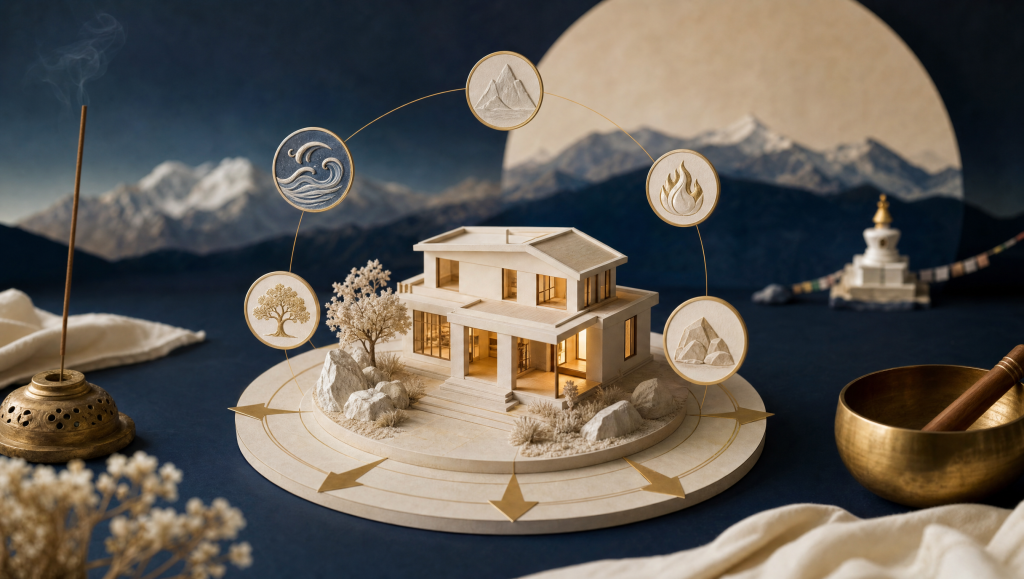
Vastu Shastra is often described as the Indian science of architecture. But at its roots, it is less about construction rules and more about a way of seeing space. It asks how the directions, the elements, and human life can live in harmony.
Vastu as spatial philosophy
In the Vedic tradition, the world is made of five elements: earth, water, fire, air, and space. Vastu maps these elements onto directions and spaces. It is a language for thinking about how a place feels and functions, not a magical formula.
Swami Aditya explains the basic idea:
“Vastu is basically a astrology for your house buildings and your business because you from north you get finance from east you get spirituality from west you get relationship from south you get protection.” (00:46:26–00:46:47)
The quote shows how Vastu relates different directions to different areas of life. These are symbolic associations, not guarantees.
Directions and their traditional meanings
- North is traditionally linked with finance and prosperity.
- East is associated with spirituality, light, and new beginnings.
- West is connected to relationships and stability.
- South is seen as a direction of protection and strength.
These meanings help people reflect on how they use space. They are not instructions that automatically create results.
A map, not a guarantee
Vastu is best approached as a traditional spatial philosophy. It can encourage mindful choices about where we sleep, work, or gather. It does not replace good design, medical care, financial planning, or common sense.
If this perspective resonates, you are welcome to explore more teachings, watch the source video, or join the newsletter for future reflections.
This article shares spiritual and cultural perspectives from the Vedic tradition. It is not medical, psychological, financial, or legal advice and does not replace consultation with a qualified professional. Vastu is a traditional spatial philosophy, not a medical or financial guarantee.